
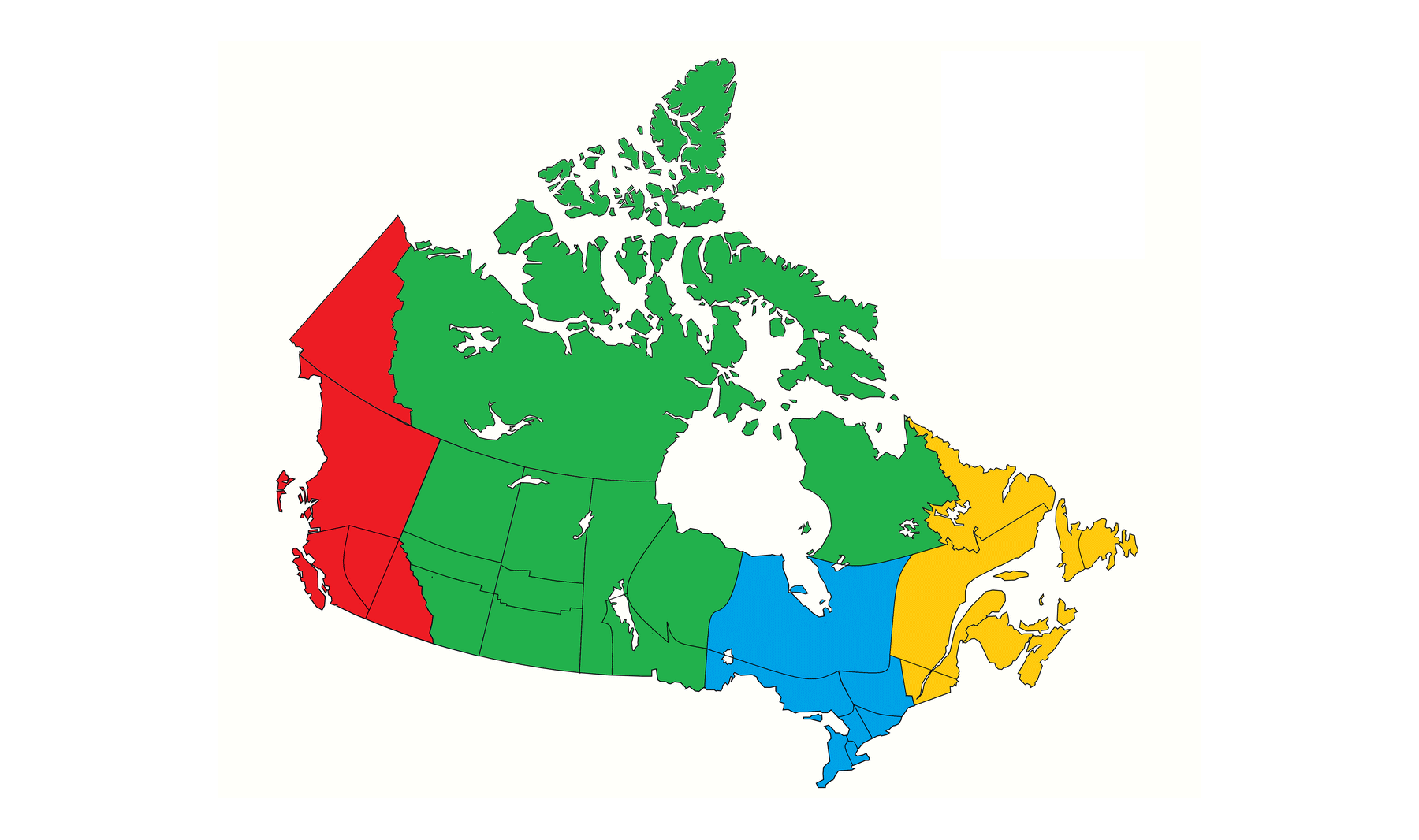
I will conclude the History of the Anglican Church in Canada with the remaining story of the expansion of Northwestern Canada (Prairies) and the Distant West from the book “Our Heritage,” circa 1946 by The Reverend R. J. Pierce.
Northwestern Canada (Prairies)
Up until World War One, immigration and the consequent growth of the Church continued steadily as the prairies filled. Unfortunately, WWI caused a grievous setback. Parishes quickly weakened or failed. However, there was a revival of life in new areas, notably in the North. The Diocese of Athabasca in 1874, in what would become Alberta in 1905, saw a great revival due to a great influx of farm families who would grow the grains and build the livestock of cattle, which Canada ships worldwide today.
After WWI, the “Soldier Settlement Board” brought in large numbers of farmers. Life was tough because they lacked farming experience, but they were devoted churchgoers who travelled long distances to attend services. A supply of clergy to minister to them was not wanting. One of them Hugh Lambertton, gave his life for Christ and his people, dying as the result of exposure on the trail while visiting in his parish of Ft. Vermilion.
The drought in the south brought in another tremendous wave of new settlers in the thirties. Church people moved from Qu’Appelle, Saskatoon, Calgary, and Edmonton Dioceses, from Montana and even Texas. Soon, more churches grew, and fresh missions began as the Church extended its influence into the community— even when it meant clergy had to spend a week traveling to connect with distant groups.
The rapid establishment of northern towns such as MacMurray, Yellowknife, and Goldfields followed the discovery of gold. Clergy moved following the influx of miners.
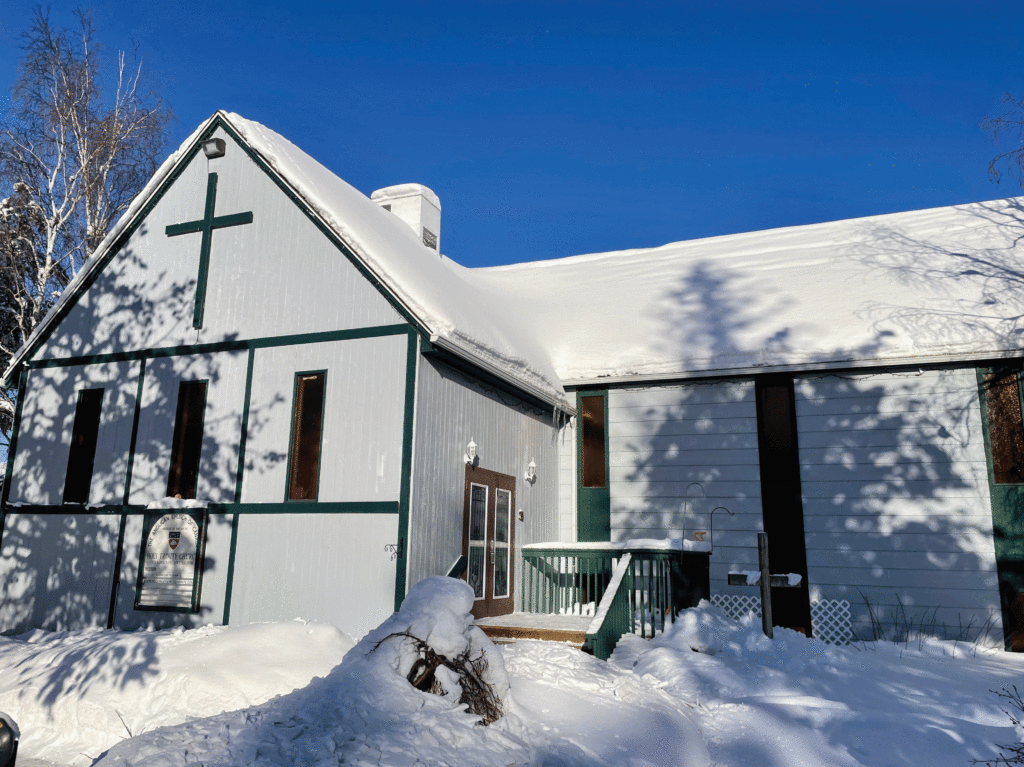
Holy Trinity, Yellow Knife , Northwest Territories.
The Bishop added the airplane, train and car, to the wagon, the riverboat and horse as his means of transportation.
A new world war came again in 1939. The laymen and clergy of our Church went with the troops. The weaker missions closed, parishes amalgamated, retired clergy came out of retirement, young people’s groups disbanded. The Lay Readers and women workers helped splendidly, but even so the Church line could not hold, as the “Perfectionist” sects were quick to seize their opportunity. A great increase in the number of clergy and in resources in the Church was required. The Bishops of the West were now striving to fill their rural parishes and provide for the spiritual needs of their country parishioners.
The Heritage in the Most Distant West
Thanks to the generosity of an Englishwoman in 1859, the first Diocese of British Columbia was created by royal decree, with Bishop George Hills as its first bishop. It originally encompassed all of British Columbia. On Vancouver Island at the time, Victoria held a cosmopolitan population of 1500.
They were adventurous days for new settlers. For one farmer and churchman, outside of Victoria, recently arrived in Saanich, it was a day’s rough journey from Victoria to the new Parish of Saanich by wagon. Bishop Hills was taken captive by indigenous people and held for several months, until the Royal Navy ultimately rescued him.
Natives and Europeans worked hand in hand. On Vancouver Island, the first missionary arrived and travelled widely to locate the Indian settlements. The Church in Nanaimo was surrounded by simple wooded houses among stumps and mud, as well as nearby Indigenous villages where violent conflicts were frequent. Initially, the indigenous population had a complete disregard for the religion preached by the missionaries. When asked, a Roman Catholic priest said he had no success with the local natives. The theft of his blankets at night proved to be the last straw and this priest was about to leave.
Gold was found along the Fraser River and in the Cariboo region, and churches were established from Hope up to the Quesnel River. Over time, new dioceses were formed as the population grew, leading to the establishment of dioceses like New Westminster (1879), Caledonia (1879), and eventually the creation of the Ecclesiastical Province of British Columbia and Yukon in 1914. The original diocese is now known as the Diocese of Islands and Inlets, and covers only Vancouver Island and the adjacent Gulf Islands. The Diocese of Cariboo was dissolved and reconstituted as the Territory of the People.
By 1900 great hardships were being endured in remote areas. The Reverend Sheldon lost his life when his canoe capsized while he was visiting sick parishioners. He was both their doctor and their clergyman. Perhaps no one showed greater devotion through this period than Mrs. Ridley, wife of the Bishop of Caledonia. On one occasion a clergyman lost heart because of hardships on the Skeena River. Without notice he returned to England. No one else was available. Mrs. Ridley made a fifteen-day journey to their location, taking a year’s supply and sleeping on the snow at night, she acted as Christian minister to the miners and the natives for a full year, living in complete isolation.
The foundations were laid in the far West up to the mid 1940s. The cities and towns of B.C., including Victoria, Vancouver, Kelowna, and Kamloops were as busy as those in the East. Churches began to flourish and reached their peak in attendance by the 1960s.
Today, we see a much different picture, with a decline in church growth. We have new challenges to overcome than our predecessors.
In closing, I wish to thank all the authors who contributed to the book “Our Heritage.” I cannot stress enough how hard all the people mentioned in the book worked to build their churches, homes and communities with the greatest of obstacles surrounding them.
Shall we be less devoted in the 21st century to our Lord than those who built our heritage across this great country.
May we find new ways and apply new energies to rebuild our Anglican community again.