
In recent days, I’ve found myself struggling with a number of unresolved tensions in my life.
Some of these tensions are personal. One such tension is between work and sabbath rest. Is it possible to create a life that leads to life, rather than to burnout and exhaustion? Is it possible to be responsive to others and their needs while also tending to my own spiritual, emotional, and physical health?
That’s one set of tensions, but there are others I experience a different scale. These arise in navigating the unresolved structural inequalities baked into our communities and society. At this scale, I can find myself beleaguered. Even if I don’t feel directly implicated in particular skirmishes, I know that I am part of the society in which these tensions manifest. I am part of a society that, by its very design, has given rise to the goods and the ills that we are experiencing. And so I wonder, what is my role in addressing the kinds of issues that beset my community, and the wider world? For example,
- What is my role in addressing income inequality?
- What is my role in addressing environmental degradation?
- What is my role in addressing rising levels of hatred?
- What is my role in addressing the fractures in my church community?
When it comes to questions like these, it’s easy to get stuck. It’s hard not to feel paralyzed. These are times I find myself looking for anything that will shortcut a return to a simpler time.
A series of snapshots scroll before my eyes, images of times I felt safe, happy, and connected. I fixate on those that depict times I felt in control, when all was going according to plan. “If only we could get back to that moment,” I think, “if only we could get back to the place where everything was just-so, then we’d all be all right.” I’ve yet to find that path.
In Laura Dunn’s 2017 film, “Look & See: A Portrait of Wendell Berry,” the filmmaker discusses her own quest to uncover that elusive sense of wholeness in this fragmented world. This is, in part, what she finds fascinating about Wendell Berry and Henry County, Kentucky, the place he calls home. On her documentary journey, Dunn admits that she is looking for “places where there is still a remnant of togetherness, or unity, or community, of connection to the land.” She studies those, she shares, “because I don’t come from a place — I come from divorce…”
That’s when Wendell Berry — farmer and philosopher, activist and author — interrupts.
Berry declares: “We all come from divorce!” This is an age of divorce. Things that belong together have been taken apart. And you can’t put it all back together again.” This observation is as incisive as it is troubling. Things that belong together have been taken apart. We can’t put them back together again. Or at least, that’s what I first heard him say.
At first I didn’t quite understand Berry’s statement. I’ve read his poetry, his short stories, and even a good number of his essays over the last twenty years. Berry’s approach is rarely defeatist. It turns out it wasn’t here, either. What I initially missed was the significance of the word “all.” We may not be able to put it all back together, but that doesn’t mean that there’s nothing to be done. “What you can do is the only thing that you can do. You take two things that ought to be together and you put them together. Two things! Not all things.”
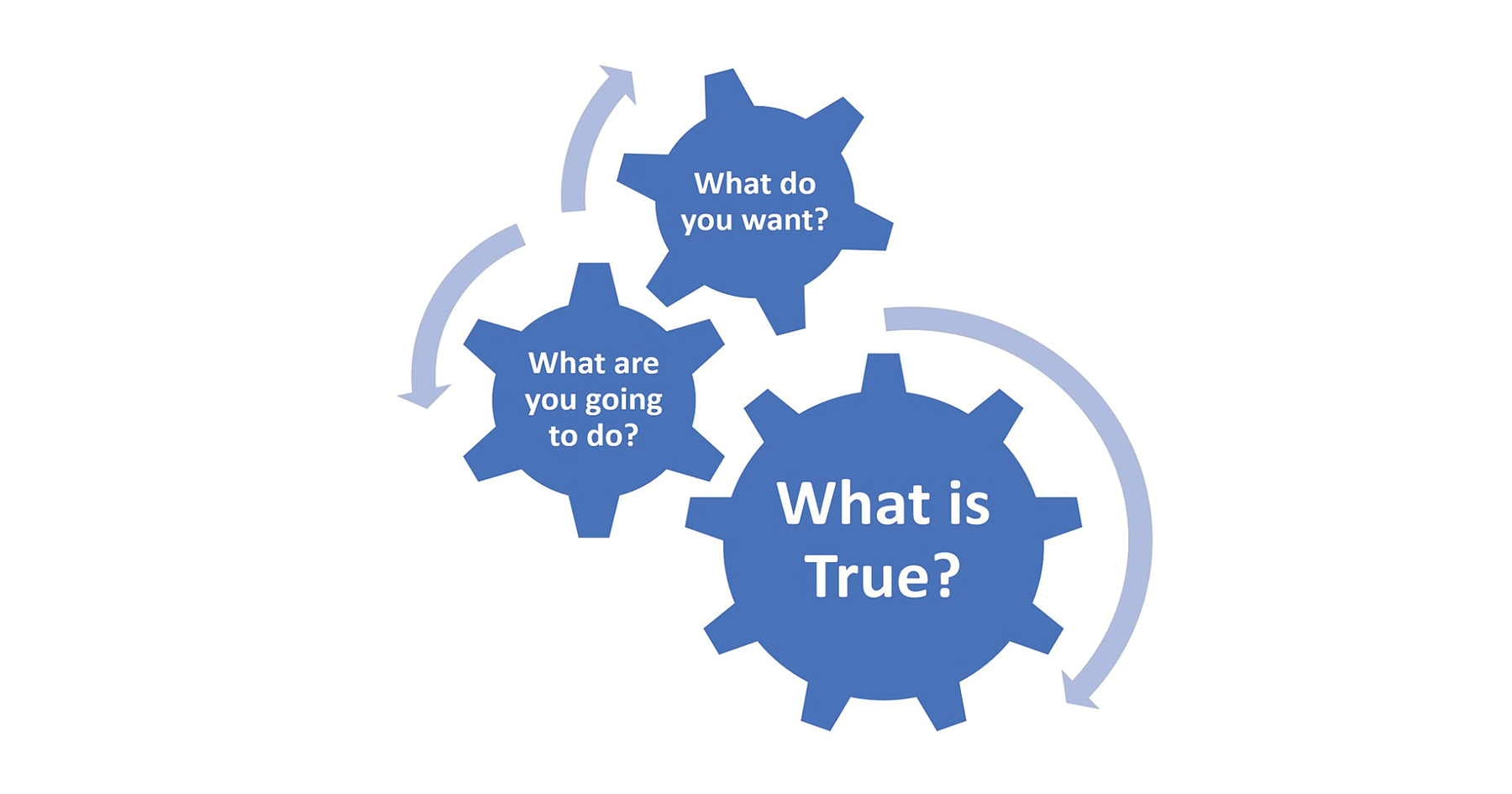
This is the work of “Right Relationship.” Not fixing the whole mess, but working together to take the two things that ought to be together, and bringing them ever closer. What Berry suggests here applies just as much to us, and our church communities, as it does in the wider world. If our discipleship; if our participation in Christ’s work of healing and reconciliation is about taking two things that ought to be together and helping to put them back together, where might we start?
Perhaps God’s call is to start with our own lives, healing inner wounds that isolate us from others. Perhaps God’s call is to start in the life of our congregation, seeking healing in our relationships with God and with one another. Perhaps God’s call is that our congregation be drawn out into the wider community, building partnerships for the common good.
Whatever God’s call for you and your community, how might each of us take our next faithful step in putting two pieces together, for the life of God’s beloved world?