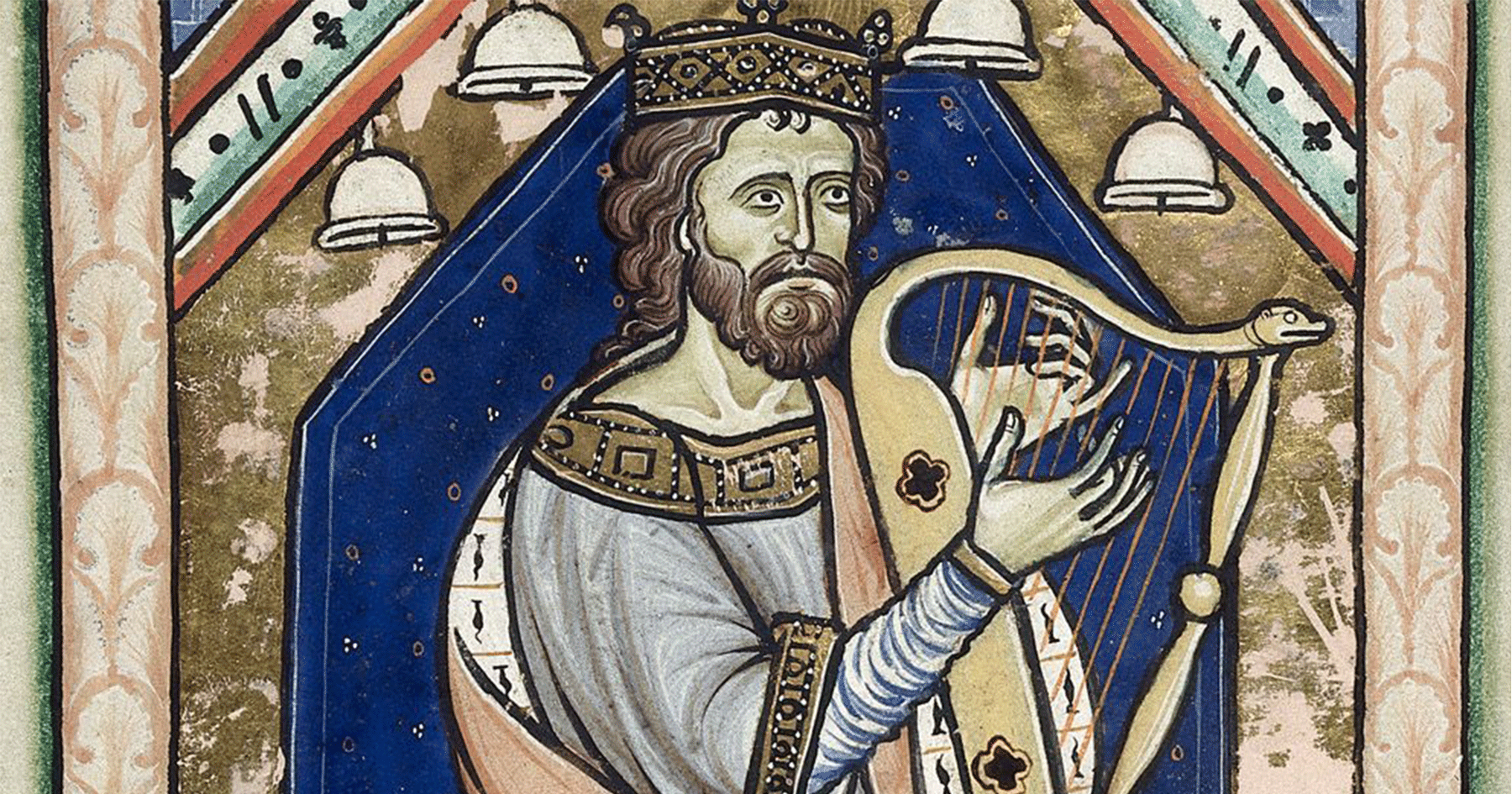
In Anglican liturgy, scripture readings are an important part of our weekly worship. All are connected by a common thread or theme which helps shape the sermon and influence the music chosen for the day. Psalms also play an important role, but in a different way because they are poems. Unlike narrative and discourse readings, poetry invites us into an experience through imagery and metaphor allowing us to ponder ideas from different angles. The psalms go one step further because they don’t stand alone. Each one has been crafted and placed in a specific order to create “The Book of Psalms,” a collection of 150 ancient Hebrew texts that come from different authors and periods in Israel’s history. Many come from King David. The rest come from Solomon, Moses, and others. Following is a brief overview of the intentional design of this collection.
The Book of Psalms is divided into five smaller books, including two introductory poems and five concluding poems.
INTRODUCTION – Psalms 1-2 were written by anonymous writers. Psalm 1 is about the blessedness of those that trust in God’s Word; Psalm 2 blesses those who trust in God’s chosen one who is yet to come.
BOOK 1 – Psalms 3-41 focus on the life of David, his personal conflict, and the struggle of the righteous against the wicked.
BOOK 2 – Psalms 42-72 represent the conclusion of David’s reign focusing on the suffering of the righteous and the longing for God’s presence.
BOOK 3 – Psalms 73-89 focus on the crisis of faith among the exiled.
BOOK 4 – Psalms 90-106 respond to the crisis with poems that ask God to show mercy, describe God’s reign, and summon all creation to celebrate a future kingdom of justice.
BOOK 5 – Psalms 107-145 affirm that God hears the cries of the people and foretells the coming of Jesus.
CONCLUSION – Psalms 146-150 are poems of praise. Each one begins and ends with “Hallelujah.”
Other layers of design reveal the following. 1) The final poem of each book ends with the words, “May the Lord, the God of Israel, be blessed forever and ever. Amen” or something similar. 2) There are two main categories of poems, those of lament and those of praise. Lament poems dominate Books 1-3 while Books 4-5 draw attention to what is good in the world and give thanks to God.
Although some psalms were sung by choirs in ancient times, “The Book of Psalms” is not a hymn book, but rather a kind of prayer book for exiles. In our present-day worship psalms may be spoken or sung. However they are delivered, psalms have a distinct format that is different from other kinds of poetry.
Firstly, psalms are written in couplets. Line 1 makes a statement, and then Line 2 develops it by 1) completing the thought, 2) deepening it with different words and images, or 3) contrasting it. All come together around a key idea. Secondly, psalms use repetitive language that allows one to focus on that one idea. This repetition may come in the form of a refrain or as “inclusio,” where the opening and closing couplets are the same or similar.
As a musician, I particularly enjoy singing psalms in chant or plainsong form. Anglican chant employs four-part harmony and follows a format where the measures are divided into a specific pattern of long and short notes while maintaining a natural speech inflection. Plainsong is sung to a single melody with unmeasured musical notation that also follows the phrasing of natural speech.
Although originally created to give voice to the exiled and to preserve their stories, “The Book of Psalms” is still relevant today. A case in point: In 1990, when my mother was hospitalized for five weeks due to a severe case of pneumonia she told me that reading the psalms gave her comfort and hope during a time when she desperately needed it. That was the only time I ever heard her speak about her faith. It showed me that psalms can give us strength as we go through pain in our lives and that we should always be forward-looking with faith and hope.