
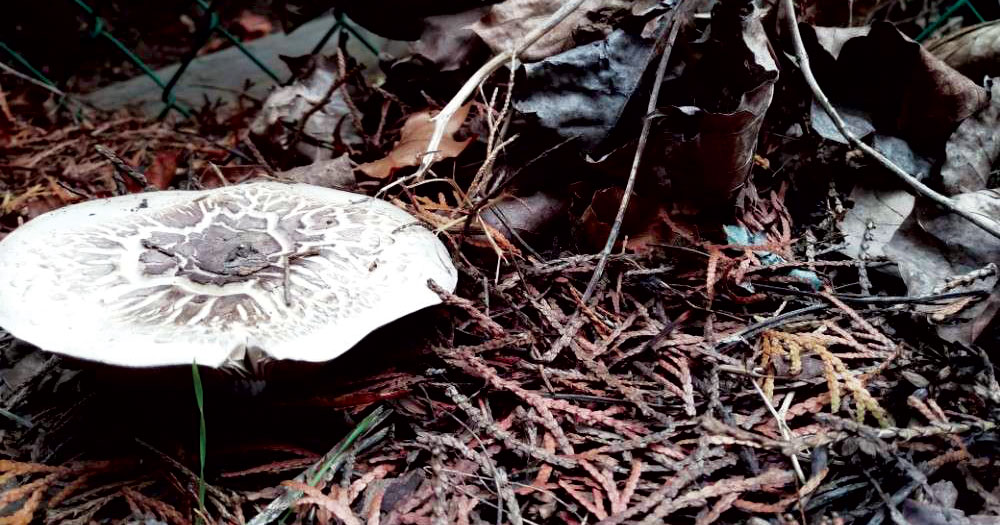
One fall day in October, I took note of this solitary mushroom outside my front door, growing among the fallen leaves and the detritus that collects along the fence line.
I had recently watched the Netflix documentary “Fantastic Fungi,” which offers a fascinating look at both fruit (the mushroom itself) and the fungi as a whole, and particularly the hidden and intricate mycelium network from which the mushroom springs.
And so this mushroom caught my attention, and I took note not only of the mushroom itself, but also, perhaps for the first time, the source of food for that mushroom: the fallen leaves, a collection of twigs, and the buildup of dirt against the edge of the fence. I imagined the roots of that mushroom extending beneath that soil, processing, digesting, and turning it all into food, not only for itself, but also for the growth of other species of plant come spring — or whenever; sometime in the future.
As for the mushroom itself, it exists only for a short time; it is ephemeral, signalling the right conditions of the renewed moisture offall, and the in-between time between the heat and growth of summer and the cold dormancy of winter. The mushroom springs up against the backdrop of decay, and indeed depends upon that decay for its own source of life, and for the sake of new life for others like itself.
The seasons of the year undergird the cyclical nature of the liturgical year in the western hemisphere — Lent drawing on the lengthening days toward the Easter celebration and the corresponding emergence of the new growth of spring. But of course, when we turn the calendar to Advent, we are still on our way into shorter days and the cold of winter. Advent signals the in-coming of something new — both past and future — and yet also sits in that seemingly fallow space of quiet, between the celebrations of the Reign of Christ and that of the Incarnation of Christ at Christmas.
Like the mushroom, Advent might be said to draw on what is ephemeral, on what is prone to decay. On the First Sunday of Advent, for example, we are reminded from the Gospel of Luke that “heaven and earth will pass away,” and we hear a warning about worrying too much, and about dissipation.
And yet we also hear that great note of Advent Hope: “but my words will not pass away,” and we hear of the abounding love of God, and by way of the Magnificat, of the mercy and justice of God at work in the world.
These words, these images, come to us across the ages from their unique place and time amid the detritus and decay that these figures livedwith, and yet as we hear them now, they emerge for us in our ownpresent, in the midst of all that has blown up against our own fences, in our own time and place, being caught there, awaiting . . . shall wesay: digestion, but also transformation into new soil for new growth, sometime in the future.
From this, the season of Advent might well produce for us its own mushrooms from that underground, interwoven network. There is a spare kind of beauty here, a tranquility that reflects the ‘bedding down’ so to speak, of the fall heading into winter. The pause to consider is the stance of waiting as a stance of expectation, of readying. Perhaps even a slowing of activity for the sake of meditation and consideration. What are the points of decay in my life, in our world? What needs digesting for the sake of new growth, new life. And can that process itself be a matter of a quiet, stately beauty in its own right?
To allow for that, it seems to me, would be to allow for a sense of trust that there is indeed something hidden and intricate beneath what the eye can see, and that affords a deep stability from which new growth might be established. The voices of Advent speak from the midst of decay, but they do so by pointing from there toward a renewal of Hope, Peace, Joy, and Love, as these are founded upon the faithfulness of God in Christ in the in-between days, “who was and is and is to come.”