
By David Tiessen ( Dean of the Cathedral Church of St Michael & All Angels, Kelowna, and Elise Lafleur (Postulant for Ordination, Diocese of Kootenay)
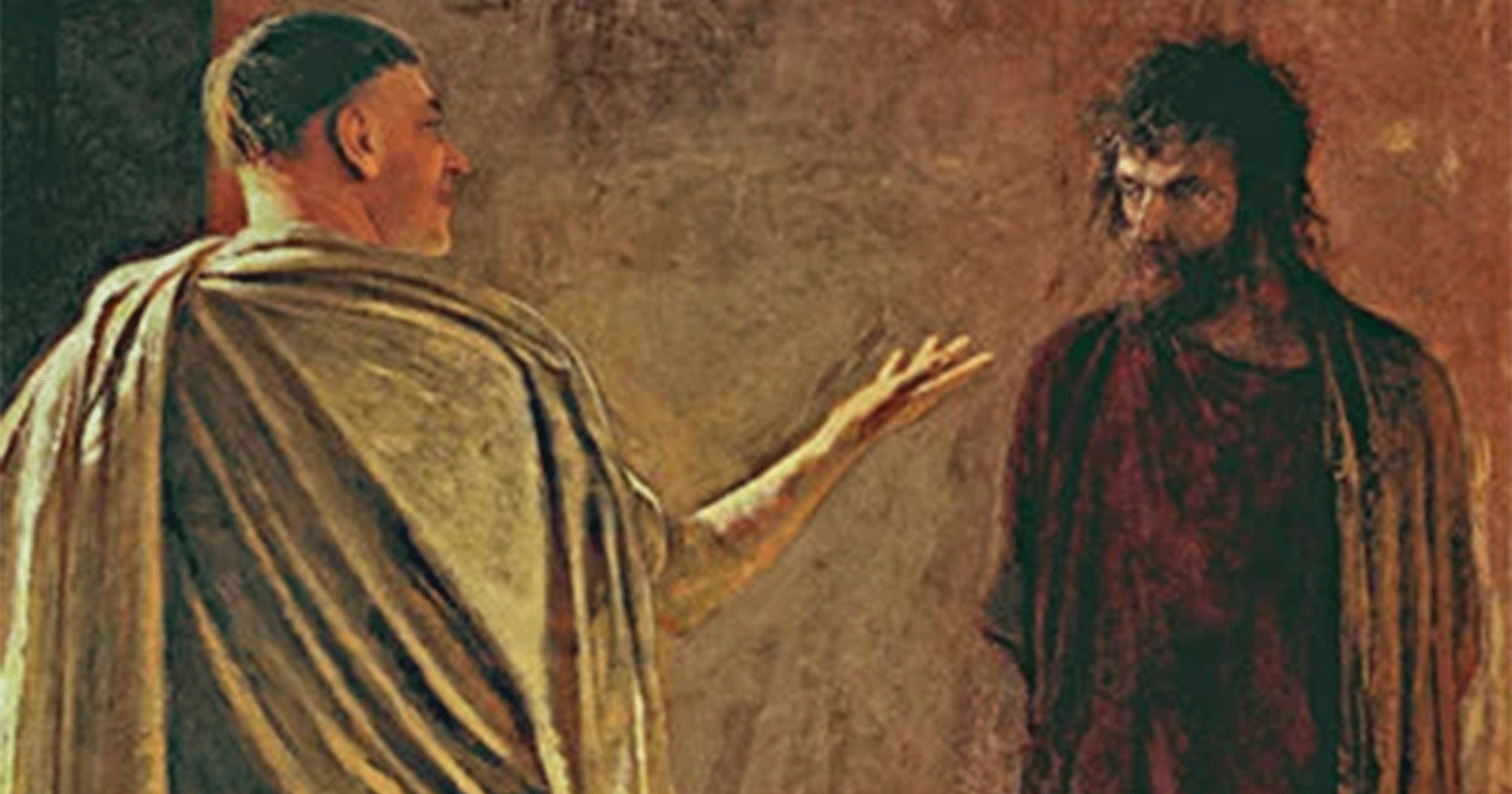
DAVID: In the Good Friday Passion Gospel we will hear again Jesus’ words before Pilate: “For this I was born, and for this I came into the world, to testify to the truth.”
Pilate’s response always stands out: “What is truth?”
A simple question. It radiates skepticism. It suggests that for Pilate truth is flexible, or pliable for the sake of wielding power, or simply used to get something one wants. It touches also the deeper epistemic question of whether the truth can be known at all.
But of course our lives also depend on truth every day – from the scientific and technical realities we explore and develop, to the basic need to be able to trust one another to tell the truth and stick to it – at least just enough to honour a contract or keep up our end of a relationship. Otherwise everything crumbles. (Even Pilate declares the truth that “Jesus is innocent,” but trades that for a politically expedient resolution to the problem standing before him.)
So it seems necessary to revisit Pilate’s question often, and particularly in an era of deep fakes, blurry lines, and bald assertions that such and such happened, or happened in a certain way, even when it is clear that something did not happen, or happened in a different way.
In our time, Jesus is still standing before Pilate speaking of the truth, and Pilate is still deflecting.
At the Cathedral, we have been enjoying having one of our diocesan postulants for ordination, Elise Lafleur (M.Div. Student, Huron University College at Western University), as our Student Assistant for the year. Part of the requirements include weekly conversations with the placement supervisor (that being me). Elise and I often have the opportunity to discuss both the practical and the theoretical aspects of church life and ministry, and some of those conversations touch on the shifts taking place in our culture relative to Christianity. The way this is unfolding is important, and affects everyone, whether Chrisitian or not, religious or not.
It might be argued that the church’s answer to Pilate’s question is simply the statement from Jesus that provokes Pilate’s response: “Everyone who belongs to the truth listens to my voice.”
But what does it mean to belong to the truth? These are questions Elise has been pondering, asking whether there is a unique way that Anglican Christians can carry that in our time…
ELISE: As a postulant for ordination, a Young Anglican ™, a zilennial denizen of the internet, and an observer of other young Christians, Anglican and otherwise, I have seen some interesting approaches to the idea of truth.
Christianity makes exclusive truth claims — “the way, the truth and the life, no one comes to the Father except through me” (John 14:6). It’s a claim that can be uncomfortable when we are trying to be anti-oppressive, pluralistic, mindful and atoning for our imperial history. But the phenomenon I am seeing is one in which Gen Zs not only rise to the demands faith places on them, but seek them out. Writing in The Sunday Times (August 18, 2025), James Marriott called it “full-fat faith”: one numinous and ritualistic, and requiring irrational belief. A religion that is not afraid to sound bizarre, trusting that it is real.
Gen Z seems to want to be challenged. Some data suggests they (we?) are returning to traditional denominations such as Roman Catholics and Orthodox precisely because of the exclusive truth claims those traditions make. Many of these trends mostly exist within subcultures, including or especially on Twitter, Instagram, and the essay/newsletter platform Substack, but subcultures which are having an increasing by real-world impact (JD Vance is one such example — at 41, he is a millennial convert to Roman Catholicism). And what about us Anglicans, who often regard it as somewhere between being in bad taste, dangerous, and immoral to suggest we are the only way? Do we have a place in this resurgence of interest in religious truth?
It’s important for me to note that this is not necessarily best practices, nor something I endorse. But I’m noticing a groundswell, a cultural movement, what last year was called the vibe shift. Towards extremism maybe? Towards intensity of belief and practice; towards certainty in an unstable world; towards a rigorous ancientness, which may or may not be reactionary.
DAVID: Since Elise hs invoked Gen Z, I want to invoke Gen X, to which I belong. One of the books that influenced me was Douglas Coupland’s “Life After God.” This was written to the “first generation to be raised without religion.” In my own case, that wasn’t true, but I was shaped by and shared in the deep cynicism of the eruption of abuses of power for the sake of money by many religious figures (e.g., televangelists) in the 80s, and Coupland’s telling of stories of lives seeking alternative meanings in a religious vacuum reflects what might be called a “generational clearing-house” which fostered a skeptical distance toward the church. As a tree-planter during university, I imagine this as clear-cut – there has been value there, but it was razed quickly, with little sense of what the new growth might look like. Perhaps my own and subsequent generations are now looking amongst the stumps and finding a variety of new growth, going in every direction. “The way, the truth, and the life,” I would want to suggest, need not be a truth claim so much as a truth confession, arising from the person of Jesus (vulnerable) standing before Pilate (power) and simply saying: this way you will find a path that expands as you walk it, drawing you into the mystery (not necessarily clarity) of God’s truth, and fostering a life that connects to others in ways that reflect what the resurrected Jesus says to Peter when he affirms that he loves him: “Tend my sheep,” and “Follow me.”